 “The next strategic objective was more
difficult: having Dubai designated as homeport for cruise liners operating in
the Middle East. We developed our port and tourism infrastructure, along with
government services like a fully computerised immigration control system. And we
made great strides in raising Dubai’s international profile with events like
the annual Shopping Festival.”
“The next strategic objective was more
difficult: having Dubai designated as homeport for cruise liners operating in
the Middle East. We developed our port and tourism infrastructure, along with
government services like a fully computerised immigration control system. And we
made great strides in raising Dubai’s international profile with events like
the annual Shopping Festival.” Abdulrahim leaned back in his chair and looked out from his office window to survey the modern skyline of his city. With a note of pride in his voice, he continued, “All these efforts paid off. Last winter a German sail cruiser, the Lili Marlene, based itself in the Creek for tours to Iran and Oman and other regional interest spots. Then the big achievement was to be designated by one of the biggest cruise line companies in the world as their Middle Eastern hub.”
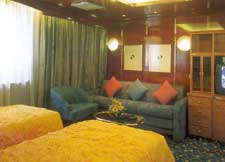
Global market strategies and government mission statements are all very nice, but success in the tourism biz really depends on how those policies translate into the experience of the tourist himself. Are we having fun yet? As regards Star Cruises, let’s check on our intrepid band of passengers as they embark on the newly christened Megastar Capricorn. At the top of the gangway, helpful hands relieve the visitors of their luggage, and the group of Arabs, Europeans and Asians is ushered into what looks like the foyer of a small exclusive hotel.
A guitarist serenades the registration process, hot towels are delicately offered with a smile and a bow, and juice cocktails are served to complete the exotic welcome for the polyglot cluster of passengers. The sheer number of uniformed staff ready to leap into action is impressive. The passenger capacity of the Capricorn’s suites and cabins is 112, while the crew fills out 115 berths. Today’s cruise is less than half full with 50 passengers, so the 1:1 ratio had gone lopsided in favour of the crew, to the obvious benefit of the guests. “Need any help, sir? Would you like another portion, ma’am? Would you like your bed turned down now, sir?”
The five star treatment is consistent down to the smallest detail. Expensive fabrics, plush carpets, the quality food, the entertainment - it’s all designed to pamper. Lawrence Lee is the Hotel Manager on board, and he explains the rationale of the expense and effort. “We’re one of the youngest cruise fleets in the world in a very competitive market. Star Cruises was founded in 1993, so we’ve made tremendous progress to now operate 70% of the cruise trade in the Asia Pacific region.
“I’m a bit prejudiced, but I think that one of the main ingredients of our success has been our motto, “Asian Hospitality”. We Asians have a great tradition of making our guests feel at home, so that’s what we train our staff to accomplish in every job they do. Our crews are from 25 countries, mostly from Malaysia, Philipines, China and Indonesia, but also a good number from countries as diverse as Australia, Turkey, Poland and Scandinavia. We take those individuals and make them into a team. How? Training, training and more training. We hire qualified and we keep them qualified.
“Star has an institute in Malaysia for training our thousands of personnel. Just like Emirates Airlines, the best testimony to this program for developing employee quality is the number of awards that we’ve won from both the cruise industry and from tourism boards that survey cruise passengers. We’re just a little bit proud of our achievements.”
Time to answer the US$200 question (the price of the ticket): What’s the ‘Cruise to Nowhere’ all about? The Finnish chief officer of the Megastar Capricorn, Captain Peik Aalto, supplies the answer. “Cruise to Nowhere is a concept that Star developed in Asia which clicked right away in that market. We board passengers at twilight who are typically professionals with their spouses or friends, shuttle them into international waters, and then cruise for the whole night and return to port early the next morning in time for work. It’s an innovative concept that proved to be a hit. Guys who are stressed out need a relaxing diversion occasionally, and sometimes couples need a little romantic detour. That’s what we deliver!”
So now Dubai has its very own Love Boat. The Captain’s blond good looks certainly served him well, because when he left the cargo industry years ago to join Star Cruises in the Far East, he not only found a new career but also a new Oriental wife who was with the company. “Star has been good for me and the other Scandinavian officers, so we were happy to be given the opportunity to head up the team to bring Star to the Middle East for the first time.” When asked if there were any differences between duty out of Singapore or Hong Kong and the Arab Gulf, Captain Peik chuckled as he told this story. “Tonight an English couple asked me if the ship was actually in motion all night, or if we stopped the engines once we got out to sea. I told them that we kept cruising at all times because of the danger of pirates.
They looked a little shocked. Then I reassured them that it was just company policy, because out in the Far East there was a problem with pirates targeting the shipping lanes. Here in the Arab Gulf, we haven’t sighted any pirates yet, at least not tonight!” That’s the Finnish sense of humour for you.
On board the big ships of the Star fleet berthing up to 2000 passengers, there are plenty of diversions to entertain everybody. That includes what can be called with Asian discretion, ‘the games’. On the smaller ships of the fleet like the Capricorn, there’s no cabaret, no sport facilities, no large swimming pool, so there’s only one attraction able to lure the large number of passengers required to float the operation. Perhaps the better greeting at embarkation might be “Gentlemen, last chance to place your boarding passes!” Or perhaps “Chips Ahoy!”
But such a public pronouncement isn’t likely for such a well-trained team.