
|
Wet Conflicts
Expanding regional populations are placing increasing demands on water supplies, meaning that water, not oil, could be the likeliest cause of future conflicts in the Middle East. By Luiza Karim
In the Middle East, water is a cardinal issue. The water crisis is not confined, however, to Palestine and Jordan. Most Middle Eastern countries suffer from a shortage, and the scarcity of water is used as a political issue and a lever. Expanding populations and expanding economies will place increasing demands on water supplies. Oil has always been thought of as the traditional cause of conflict in the Middle East past and present. Since the first Gulf oil well gushed in Bahrain in 1932, countries have squabbled over borders in the hope that ownership of a patch of desert or a sand bank might give them access to new riches. No longer. Now, most borders have been set, oil fields mapped and reserves accurately estimated - unlike the water resources, which are still often unknown. Water is taking over from oil as the likeliest cause of conflict in the Middle East. When President Anwar Sadat signed the peace treaty with Israel in 1979, he said Egypt will never go to war again, except to protect its water resources. The late King Hussein of Jordan said he would never go to war with Israel again except over water and former United Nation Secretary General Boutros Boutros-Ghali warned that the next war in the area will be over water. From Turkey, the southern bastion of Nato, down to Oman, looking out over the Indian Ocean, the countries of the Middle East are worrying today about how they will satisfy the needs of their burgeoning industries, or find drinking water for the extra millions born each year, not to mention agriculture, the main cause of depleting water resources in the region. All these nations depend on three great river systems, or vast underground aquifers, some of which are of 'fossil water' that cannot be renewed. Take the greatest source of water in the region, the Nile. Its basin nations have one of the highest rate of population growth which are likely to double in less than thirty years, yet the amount of water the Nile brings is no more than it was when Moses was found in the bulrushes. Figures of population growth in the Middle East leaves little room for optimism. Israel's population is projected to grow from 4.7 millions in 1990 to about 8 million in 2025. By that time Palestinians in the West Bank - because of their higher birth rate, are likely to reach just under seven millions- the two peoples are to share the same water resources which they both now say are not enough. Jordan's population more than doubled from 1.5 millions in 1955 to 4 millions in 1990 and is projected to double again before 2010. Their annual per capita water availability in 1990 was 327 cubic meters some 673 below the bottom line of crisis. Iran for example had 2,025 cubic metres per capita in 1990, the figure projected for 2025 is between 776 and 860 cubic meter. Libya's population of 4.5 million in 1990 is projected to increase to 12.9 million in 2025 and the oil revenues enabled the government to increase dependency on desalination, but they diverted - or rather wasted massive resources on a white elephant, the great man made river to mine fossil water in the south. Egypt's 58 million in 1990 are projected to reach 101 millions in 2025 and already approaching water scarcity: its per capita availability is 1,017.
White Elephants Some irresponsible - even corrupt - western experts, academics and advisers to western construction companies go on advising the Arabs to build white elephants like Libya's project or Saudi Arabia growing wheat in the desert and depleting the water table below sea level increasing salinity. According to Adel Darwish, author of Water Wars: Conflict in the Middle East, those experts and academics know they are giving wrong and dishonest advice. Their greed for fees paid by construction companies or some governments in the Middle East make them opt for projects that would make the media show water gushing in abundance, which is a short term solution. But such projects by nature sharpen the water crisis on the long term, thus bring the possibility of open conflict even closer.
Several discussion with some of those experts, and examining their reports, indicated that they have lacked the political advice of non-partisan specialist, while some also ignored the environmental and human factors (examples the Nubians in the Asswan Dam, the silt. As a result of slowing the current, pollution is behind 40 per cent of kidney chronic disorders in Egypt. The lack of silt resulted in an increase in the use chemical fertilizers. The salinity in drainage has reached 340 in a million that is seven times higher than the safety level.)
Gulf In Crisis He warned that in Yemen, once regarded as the garden of the Arabian peninsula, the introduction of diesel pumps over the last 30 years risks literally pumping the country dry. In the basin around Sana'a, for example, four times more water is pumped out than is recharged by streams and run-off. Water tables are sinking several meters every year and, as in many cities of the developing world, poor people pay 5 times more for a bucket of water than it costs people in The Hague or Washington, D.C. Unfortunately, this kind of scenario is not restricted to Yemen. It is estimated that 10 per cent of the world's food is grown with water from aquifers which are being depleted faster than the rate of recharge. Saudi Arabia is another country rapidly approaching a dramatic crisis over water. In Saudi Arabia's case, however, the crisis stems from the country's lack of rivers and permanent bodies of water, as a result of which it relies heavily upon underground water sources for its agricultural and potable water supply. At present, 90 per cent of Saudi Arabia's non-renewable deep-well water is utilised for agricultural purposes. These resources, already precariously low, have been significantly eroded in recent years as a consequence of the Arabian Gulf conflict. Iraq's burning of oil wells during the Gulf War further contaminated underground water resources already degraded by pollution seepage from agricultural activity, creating a deficit that has failed to be resolved to date, despite significant Saudi desalination attempts. Though buoyed by oil revenues, which have facilitated massive desalination efforts, Saudi Arabia has failed to adequately address its growing water concerns. Consequently, Saudi Arabia has begun to seek other water sources, a focus that has had pronounced effects on the region. Saudi Arabia's extensive exploration into the underground aquifers in its Eastern Province has reduced the agriculture and water availability of Qatar and Bahrain. Disputes are becoming visible between Saudi Arabia and Jordan over the Qa Disi Aquifer. Though currently utilised almost exclusively by Saudi Arabia, Jordanian vested interest in the aquifer, which runs beneath both countries, has increased in recent years, with Jordan's Minister of Agriculture accusing Saudi Arabia of overuse of the aquifer as far back as November 1992. Expanding Jordanian utilisation of the aquifer, which is likely in light of Jordan's looming water crisis, may emerge as a contentious issue between the parties in the near future. Depleted by expanding populations, rising birthrates and growing agricultural initiatives, water is redrawing the geopolitical landscape of the Middle East. Already considered a zone of conflict in international planning, the Middle East stands poised to deteriorate into regional infighting over water allocation and accessibility. To date, the volatile politics of the region have arrested the implementation of progressive efforts at water sharing. Turkey's proposed "peace pipeline" - designed to carry water from the Turkish Seyhan and Ceyhan Rivers to Saudi Arabia, Kuwait and other Gulf states - has, as a result of regional fears of dependence, failed to progress beyond the planning stage. Other regional initiatives, such as importing water by sea and comprehensive interstate water allocation, have also failed, threatened by fragmented politics and historic distrust. This deadlock has eloquently illustrated water's integral role in the larger balance of power equation in the Middle East, where water-planning issues have become a function of the security and stability of regional regimes. Future efforts to normalise regional tensions over water will hinge upon the equitable distribution of available resources, and the creation of security frameworks to ensure their safety and stability.
Water Politics In addition to its scarcity, much of Middle Eastern water stems from three major waterways: the Tigris-Euphrates, Nile and Jordan River systems. Mutual reliance on these resources has made water a catalyst for conflict, spurring confrontations such as the 1967 War (fomented by Syria and Israel's attempts to divert water from each other) and the Iran-Iraq War (which erupted from disputes over water claims and availability). Recognition of water's role as an obstacle in interstate relations has spurred numerous attempts at resolution, including diplomatic efforts (most notably the 1953-1955 U.S.-brokered Johnston negotiations) and bilateral and multilateral treaty efforts, ranging from the 1959 Agreement for the Full Utilization of Nile Waters to the 1994 Israeli-Jordanian Treaty. Increasingly, however, and despite these agreements, nations have begun to come into conflict over water. The natural scarcity of regional supplies, historically a point of contention, has been reduced to crisis proportions by a variety of factors. With population rates among the highest in the world, countries in the Middle East are consuming water at a much higher rate than can be replenished naturally. Rising populations, estimated to reach 423 million by the turn of the century (and double 25 years thereafter), have increasingly affected water resources in the region. In an area already critically short of water, this depletion has been compounded by domestic pollution, which has contributed to a deterioration of usable resources and a general decline in the quality of available water. Furthermore, expanding initiatives in agriculture and industry have further eroded regional water availability. Spurred by growing populations, many nations have begun to overexploit their agricultural capabilities, resulting in desertification (reduction of arable land). As a result of these factors, per capita water availability in the Middle East has become the worst in the world, representing only 1/3 of Asian and 15 per cent of African levels. While progressive agricultural methods - such as drip irrigation - exist, they have, as a result of prohibitive costs, been implemented by only a handful of states. Nor have current desalination efforts in the region proven capable of meeting growing demands. The high energy and large costs associated with seawater desalination have limited efforts to cash and energy rich oil-exporting countries such as Oman and Saudi Arabia. Influenced by declining availability and reductions in overall quality, crisis zones have begun to emerge along the major rivers of the region. Evolving conflicts - between Turkey and Syria over the Tigris and Euphrates Rivers; in the Jordan River Basin between Israel, the Palestinian Authority and Jordan; among Egypt, Sudan and Ethiopia over the Nile River; and within Saudi Arabia - are manifestations of water's growing role as a strategic and political force.
Glimmer of Hope The second conclusion is that whenever political conditions permitted, the water supply has always expanded to meet population requirements. Throughout the period of the British Mandate, experts were convinced that the land between the Jordan and the sea could not comfortably support any great population increase. As the population increased, the standard of living went up however, and new sources of water were found, turning arid and unusable land into productive farmland and orchards. This did not prevent the experts from issuing increasingly dire predictions that Palestine would run out of arable land and of water. The 1946 Anglo-American Survey of Palestine concluded quite self-assuredly that well-water would remain the basis of water supply in Palestine, and that irrigation schemes based on pumping water from the Jordan were impractical and costly. They were wrong of course. The third conclusion is that feasible peaceful solutions to the water problem are at hand. Desalination programs or import of water from neighbours such as Turkey, for example. Isseroff argues that the most important conclusion is that despite the existing water crisis, many political leaders want to use this issue for their own ends. If there is a water war, it will not be the water that caused the war. Rather the war will be due to belligerence that was in search of an issue, and helped perpetuate the water crisis as an excuse for war.
|
 Of all the water on earth, 97.5 per cent is salt water, and of the
remaining 2.5 per cent fresh water, some 70 per cent is frozen in the
polar icecaps. The other 30 per cent is mostly present as soil moisture
or lies in underground aquifers. In the end, less than 1 per cent of the
world's fresh water (or about 0.007 per cent of all water on earth) is
readily accessible for direct human uses.
Of all the water on earth, 97.5 per cent is salt water, and of the
remaining 2.5 per cent fresh water, some 70 per cent is frozen in the
polar icecaps. The other 30 per cent is mostly present as soil moisture
or lies in underground aquifers. In the end, less than 1 per cent of the
world's fresh water (or about 0.007 per cent of all water on earth) is
readily accessible for direct human uses.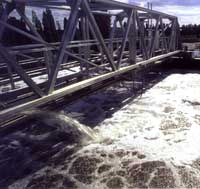 The majority of engineers and hydrologists are honest, but in their
planning of dams, diversions and more desalination plants and trying to
improve water use and eliminate leaks and reduce evaporation ( the
figures are astronomical but 15 per cent of all water in the region is
lost through leaks and 20 per cent to evaporation ) and inefficient
irrigation ( 60 percent is lost before reaching the crops and orchards
to be watered).
The majority of engineers and hydrologists are honest, but in their
planning of dams, diversions and more desalination plants and trying to
improve water use and eliminate leaks and reduce evaporation ( the
figures are astronomical but 15 per cent of all water in the region is
lost through leaks and 20 per cent to evaporation ) and inefficient
irrigation ( 60 percent is lost before reaching the crops and orchards
to be watered).