|
The Impact of Oil
A year ago oil prices were at a 25-year low, but since then prices have tripled. Lynda Cusack assesses the effect this has on a region that relies on oil as its main source of revenue.
Oil, or "black gold", has always played an important role in the world economy, but nowhere have these fluctuations had more of an immediate and dramatic impact than in those countries which rely on oil exports as their main source of revenue. It is no accident that the Gulf Cooperation Council (GCC) oil producers, some of the world's largest, all felt the blow of rockbottom oil prices in late 1998 and early 1999. Their revenues were sharply reduced, their stock markets took a hit and other projects had to be put on the backburner. Nearly all the Gulf Arab states issued austerity budgets for 1999, and a process of economic belt-tightening began as the implications of such lowly oil prices began to sink in. Then last March in Vienna, producers from the Organisation of the Petroleum Exporting Countries (OPEC) and others signed an agreement imposing tough curbs on oil exports in order to end a supply glut and revive the drooping prices. The deal removed 2.1 million barrels a day from the international market, and since then producers have largely stuck to quota limits agreed at that meeting. The result has been a surge in the global price of crude oil to its current heady heights of more than US$28 a barrel, and some analysts say they could go as high as US$30 a barrel. The huge surge in oil prices has so far brought OPEC at least US$25 billion in extra export revenues, according to a study by the London based Centre for Global Energy Studies. The GCC is made up of Bahrain, Oman, Kuwait, Qatar, the United Arab Emirates and Saudi Arabia. All of these states are oil producers, but Bahrain and Oman are not members of OPEC. The upside to the economic doom and gloom suffered by Gulf Arab states through the end of 1998 and early 1999, was that reduced oil revenues meant countries had to look to other sources to boost their income and reduce their dependency on oil - particularly given its volatile nature. Crown Prince Abdullah of Saudi Arabia told a GCC summit meeting, now famously, at the end of 1998 that the boom days of easy petrodollars were gone. It seems that his fellow GCC leaders have heeded that call. To take an example, Oman has now moved ahead on the privatisation of its power and telecoms sectors, while Qatar is looking to petrochemicals and natural gas to supplement its income. The United Arab Emirates (UAE) continues to sustain one of the more diversified economies in the region, building on its reputation as a tourism and business destination, as well as home to one of the world's largest aluminium producers - Dubal. Analysts also point out that the UAE was more able to ride the storm of low oil prices than many of the other GCC states as its considerable overseas investments and prudent economic management cushioned it against the worst of the oil price slide. Abu Dhabi, for example, is estimated as having overseas funds of more than US$100 billion. There are no official figures.
Several Saudi banks estimated that fiscal changes made in the kingdom last year, including a 50 per cent hike in domestic gasoline prices, the imposition of a departure tax for international travellers and a rise in the price of work visas for foreigners, would cumulatively bring in an additional one billion dollars to the government coffers in 1999. But, just as 1998's slide in oil prices was not all bad news for producers, so unremittingly high oil prices do not necessarily equal unqualified good news for oil producing states. If prices get "too high" - the trouble being that no-one really knows exactly what that level is - it could have serious implications for the global economy, hampering economic growth, increasing inflationary pressures and reducing energy demand. This in turn, would have a knock-on effect on the Gulf oil producers, especially given that attracting foreign investment is a major part of their push for economic diversification. In addition, squeezing consumers too hard on prices could result in more supplies being teased out from non-OPEC producers, so diluting OPEC producers' market share and possibly also pushing prices lower again. "Most oil producers recognise that any extended period of high prices threatens their own interests. Prices at that level are probably unsustainable anyway," a recent article in the Wall Street Journal commented. In recent weeks there has been speculation that the United States, the world's largest oil consuming nation, might drain some crude from its huge strategic reserve stockpile of oil, in order to reduce inflationary pressures being created by soaring oil prices. But the government has so far downplayed this as a possibility, saying there are no plans to release oil from the reserves in the "current market context". "I urge - in the strongest terms - that all oil producing nations recognise that the world needs more oil, not less, and needs it sooner rather than later," US Energy Secretary Bill Richardson said recently. While the outgoing head of the International Monetary Fund, Michel Camdessus, said soaring oil prices remained "a question mark" and concern for the world economic outlook. OPEC producers are due to meet in Vienna once again on March 27 to discuss the future of their pact, which was originally set to run one year. The existing curbs from last March's meeting expire in March 2000 and market sources are suggesting that producers will probably raise output levels after the agreement ends if prices stay up around current levels. One Gulf source has said that a persistent US crude price of US$30 a barrel would be enough to trigger further supplies to the market. While a source close to recent talks between Saudi Arabia, Venezuela and Mexico, said the three oil-producing heavyweights were agreed that markets had swung too high and that extra supplies should be released to dampen prices. But the three producers could face difficulties convincing some of their fellow producers at the Vienna meeting - who are keen to keep prices high - that supply limits should be eased any time soon. Gulf OPEC producers UAE and Qatar are also understood to sympathise with the Saudi position that extra oil could be needed as soon as April. Oil officials from the six GCC states, as well as other producers, are due to hold a meeting to discuss the oil market situation before the March 27 OPEC meeting. Market stability is probably the one most important thing they need to achieve, and finding the right level to stabilise the market at probably the most difficult. Keeping tough curbs in place would also mean producer countries were put under constant pressure, as they would constantly be aware that an excess capacity of around nine per cent of world demand would have to be kept from entering the market. "OPEC's challenge now is to maintain prices at or around current levels, but without letting them spiral out of control," one oil newsletter concluded. It is this happy medium that OPEC and the world now needs to find, and the reason why all eyes will be on the oil producers' next meeting in Vienna in March. Another difficulty OPEC faces is to engineer a rise in output - if that is what it chooses to do - without percipitating a price collapse as more supply comes on to the market. Again, stability and a finely tuned balancing act will be the watchwords for the oil community.
Caution The growth in GCC economies seen in 1999 can be put down to a direct result of the enormous rise in oil prices - and therefore government revenues - from March last year. "If we correlate GDP growth with oil prices in Saudi Arabia we will find a perfect correlation, and within the other GCC countries a very good correlation," Henry Azzam, chief economist at the Beirut-based Middle East Capital Group, recently told an investment conference in Dubai. All GCC states recorded growth in 1999, and all are expected to continue growing into 2000 as analysts say oil prices are now set to stay around these high levels throughout the year A report by Saudi American Bank said the kingdom's GDP was expected to rise around six per cent in nominal terms in 2000 thanks to high oil prices and economic reforms in the kingdom, while real GDP was seen growing two per cent. And in the UAE, Minister of Planning Sheikh Humaid bin Ahmed al Mualla said GDP was projected to touch 203.5 billion dirhams by the end of the year - an increase of 7.1 per cent. But despite this forecast growth, they have all issued prudent budgets for 2000 and most have used a very cautious oil price in calcuating their latest budgets. For example, Qatar has said it is to base its 2000-2001 budget on a conservative price of US$15 a barrel for Qatari oil, even though the international price has been some US$6 higher. "There is no going back to loosening the purse," a senior Qatari official was quoted as saying. Saudi Arabia, the world's largest oil producer and exporter, does not officially release the oil price it uses as the basis for its budget, but some analysts estimated it to be around US$18 a barrel for Saudi crude. This prudency will pay off when the accounts are calculated at the end of the year, and also provides them with a form of "safety blanket" in the case of any further shocks in the global oil market. It will also give Gulf Arab states room to continue economic diversification and boosting the role of the private sector, not only to sustain or increase economic growth, but also in finally reducing the region's dependency on oil. There may seem to be no end to the bullish grip on the market right now. But we have seen it all before in the 1970s and 1980s and Gulf governments are wise to manage their economies while they have room to do so. "High oil prices were the highlight of Saudi economic developments in 1999...and 1999 ended as a turnaround year for the Saudi economy, from a path of deterioration to one of improvement," said Brad Bourland, chief economist at Saudi American Bank, in a report. Aside from the Gulf Arab economies, Gulf stockmarkets were also led a merry dance through 1998 and 1999, following, as they are wont to do, the fortunes of the oil market. Analysts said those markets which staged recoveries in 1999 had benefitted directly from the surge in oil price over the course of the year. Those that did not perform so well over the same twelve months were in many cases suffering from bruised investor confidence, hit when markets crashed in 1998 as global oil prices collapsed. Lack of confidence could be seen in the thin volumes recorded on some of the Gulf bourses through the first half of last year while investors stayed on the sidelines and waited to see what would happen. Many economists, forecasting oil prices to remain steady at higher levels throughout 2000, say Gulf stock markets should perform better this year. However, oil prices will remain a dominant factor for them. Therefore it becomes clear that for the Gulf Arab states, high oil prices have provided short-term relief, but cannot necessarily be seen as a long-term antidote giving the stability the world oil market needs. And this can be seen to be relevant to the long-term interests of both oil producers and consumers throughout the world. |
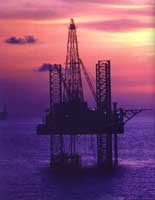 Around this time a year ago, global oil prices were floundering at
25-year lows, at some stages dipping below US$10 a barrel. A year later,
the price of international benchmark Brent crude oil has more than
tripled to trade above US$28 a barrel, and analysts say it could go
higher yet. The move over US$28 a barrel was the first time prices had
reached these heights in nine years, and it set a fresh post-Gulf War
high.
Around this time a year ago, global oil prices were floundering at
25-year lows, at some stages dipping below US$10 a barrel. A year later,
the price of international benchmark Brent crude oil has more than
tripled to trade above US$28 a barrel, and analysts say it could go
higher yet. The move over US$28 a barrel was the first time prices had
reached these heights in nine years, and it set a fresh post-Gulf War
high. One Dubai-based banker estimated that due to this economic "buffer zone"
the UAE could withstand a lower oil price for another two to three years
without feeling too much pain. "People looking at the UAE as a whole
would certainly have said in the past that while it is a nation that is
dependent on revenue from oil, they have used that revenue well," he
said.
One Dubai-based banker estimated that due to this economic "buffer zone"
the UAE could withstand a lower oil price for another two to three years
without feeling too much pain. "People looking at the UAE as a whole
would certainly have said in the past that while it is a nation that is
dependent on revenue from oil, they have used that revenue well," he
said.