|
Al Habtoor Motors
Derek
Skehan, Group Spare Parts Manager for Al Habtoor Motors, is one of those leading the fight against the trade which is harming the UAE economy, as well as endangering lives. “The ball is rolling, but quite slowly,” he said. “But there is support from the economic department and the police to combat the problem in Dubai and, when a stand is taken here, then I am sure the other emirates will follow suit.” Derek first proposed the idea of a unified approach being taken by the motor industry in early 1997 when he wrote to his counterparts in other companies suggesting a meeting to discuss the problem. “The response was phenomenal,” he said. “We all got around the table and took it from there. We got advertising people in to see how we could develop it and met with the economic department who were in full support. “We even came up with a collective name: GUARD - Genuine UAE Autoparts Retailers and Distributors - but enthusiasm for the project dropped until last year when the economic department proposed setting up a committee to examine and tackle the problem.”
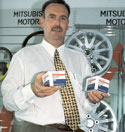
The sort of fake products which have been found in the market is astounding - from Coke cans drilled with holes to act as filters, to brake pads stuffed with sawdust. “The Dubai courts have started coming down heavily on people found to be trading in pirated computer games, software and videos with stiff fines and even jail sentences but if I go out and buy a counterfeit CD it will damage the market but it won’t be detrimental to my health. However, if I buy a counterfeit set of brake pads then the ramifications could be very serious indeed.” The people dealing in fake car parts are becoming increasingly sophisticated in the way they package their products, which Derek illustrates with two virtually identical oil filter boxes on a shelf in his office at the Al Habtoor Motors showroom on Al Ittihad Road in Deira. Both have ‘Genuine Part’ written on the side but only one is accompanied by the Mitsubishi logo. The average customer would have no idea the other is a fake from its appearance. But in some cases there will be no difference as the box will be genuine when the part inside is not. “Some of the back street garages involved in this trade are getting clever. They go around collecting legitimate, genuine boxes which have been discarded and put a counterfeit part inside which really gives customers no idea of what they are buying,” Derek explained. “But we are working with lawyers and private investigators to actually find the sources in order to set up raids by the police and economic department. We set up some pretty successful raids in Dubai recently but doing it is a laborious process which takes time and resources. First we find a source and go in and buy the parts and get invoices with all the details on them which we then take to the economic department and pay to register a complaint. “They are pretty good and will usually come out with you the next day and raid the premises along with the police and municipality officials. But when we inspect the outlet’s books and see they got the parts from a different supplier in Dubai, we have to go back to the economic department and file another case before we can go and raid the next one in a bid to get to the main supplier. “This is what makes it such a time consuming process. It needs to be streamlined, but also another problem is the lack of commonality in the legal systems in the different emirates. For example, to do a similar operation in Sharjah we have to follow a totally different procedure. “There are huge warehouses in the UAE filled with fake parts for distribution. There are also printers that we know of turning out the boxes, but because these smaller shops and retail outlets don’t have substantial overheads, when we set up raids we’ll close them down only for the same guys to open up again around the corner a couple of days later. It’s an ongoing battle and the only real way to stop it is at the source.” The fake parts available in the UAE market are mostly imported from India, Iran, Taiwan, Hong Kong and Singapore.
“There is a ‘souq mentality’ among a lot of people in the UAE, especially in the motor trade where the common question is ‘what’s the last price?’ People want and expect a discount, but you wouldn’t go into a supermarket or McDonald’s and start haggling over the price. “But I really have no sympathy for people who work on price alone. If two products are in the same box but one is Dh 50 and one is Dh 10 you would automatically know which was the counterfeit and which wasn’t, but there needs to be an awareness campaign so people know what risks they are taking by buying fake parts. “A television advert showing someone’s face after they had been through the windscreen of a car was run by the UK government when seat belts were made compulsory there with the slogan ‘Clunk, Click Every Trip’ and I think similar shock tactics could be used here showing the possible effects of using counterfeit brake pads. “But the only way to ensure you are getting a genuine product is to go to the main dealer. Outside that you are taking a risk. We have been approached by many people over the years asking us to sell their parts, but we wont jeopardise the credibility that we have got. I have got 50,000 parts in my warehouse and every one of them is 100 per cent genuine.” The World Trade Organisation As a condition of joining, the UAE has just a couple of years left before it will have to abide by the global rules of trade it has committed itself to. This is expected to see a significant change in the way business is done in the country with traditional monopolies and franchises enjoyed by individual companies likely to be broken up to allow a freer flow of trade and greater choice for consumers. Derek
Skehan, Group Spare Parts Manager with Al Habtoor Motors, says this will mean the battle for market share will be won and lost on the quality of customer service. “I believe there is a hole in the quality of service that is offered generally in the UAE. I would say that 95 per cent of it is here. It’s happening but it is the other five per cent which isn’t that is frustrating. “It’s that five per cent which needs to be developed and extended as the battle is going to fought on quality of service. If you look around the Western world now, billions of dollars are being invested in training. These companies aren’t doing that just for the sake of it. They recognise that the biggest asset a company has is its people. If you haven’t got the right people then your customers will find an alternative supplier.” Improving customer service is also viewed by Derek as a means of attracting greater foreign investment into the UAE, which will also be aided by the implementation of WTO agreements. “If there is going to be more outside investment, then foreign investors are going to be looking for high standards of customer service as a prerequisite.” The WTO came into being in 1995, making it one of the youngest of the international organisations, but its origins lie in the General Agreement on Tariffs and Trade (GATT) which was established in the wake of the Second World War. It is the only international organisation dealing with the global rules of trade between nations and its main function is to ensure that trade flows as smoothly, predictably and freely as possible. The WTO has more than 130 members, accounting for over 90 per cent of world trade, and over 30 other nations are currently negotiating membership. The past 50 years have seen an exceptional growth in world trade. Merchandise exports grew on average by 6 per cent annually. Total trade in 1997 was 14-times the level of 1950 with GATT and the WTO having helped create a strong and prosperous trading system contributing to unprecedented growth. A WTO spokesman said: “The result is assurance. Consumers and producers know that they can enjoy secure supplies and greater choice of the finished products, components, raw materials and services that they use. Producers and exporters know that foreign markets will remain open to them. The result is also a more prosperous, peaceful and accountable economic world.” Decisions in the WTO are typically taken by consensus among all member countries and they are ratified by members’ parliaments. Trade friction is channelled into the WTO’s dispute settlement process where the focus is on interpreting agreements and commitments, and how to ensure that countries’ trade policies conform with them. At the heart of the system — known as the multilateral trading system — are the WTO’s agreements, negotiated and signed by a large majority of the world’s trading nations, and ratified in their parliaments. These agreements are the legal ground-rules for international commerce. Essentially, they are contracts, guaranteeing member countries important trade rights. They also bind governments to keep their trade policies within agreed limits to everybody’s benefit. The WTO’s top level decision-making body is the Ministerial Conference which meets at least once every two years. Below this is the General Council - normally ambassadors and heads of delegation in Geneva, but sometimes officials sent from members’ capitals - which meets several times a year at the WTO’s Geneva headquarters. The General Council also meets as the Trade Policy Review Body and the Dispute Settlement Body. At the next level, the Goods Council, Services Council and Intellectual Property (TRIPS) Council report to the General Council. Numerous specialised committees, working groups and working parties deal with the individual agreements and other areas such as the environment, development, membership applications and regional trade agreements. The first Ministerial Conference in Singapore in 1996 added three new working groups to this structure. They deal with the relationship between trade and investment, the interaction between trade and competition policy and transparency in government procurement. At the second Ministerial Conference in Geneva in 1998 ministers decided that the WTO would also study the area of electronic commerce, a task to be shared out among existing councils and committees. The WTO Secretariat, based in Geneva, has around 500 staff and is headed by a director-general. Since decisions are taken by the members themselves, the Secretariat does not have the decision-making role that other international bureaucracies are given. The Secretariat’s main duties are to supply technical support for the various councils and committees and the ministerial conferences, to provide technical assistance for developing countries, to analyse world trade, and to explain WTO affairs to the public and media. |
 Accident investigators found the tires had been imported from Asia, were of low quality and did not conform to safety standards - helping lift the lid on a black market trade in fake and substandard products that costs genuine retailers millions of dirhams a year.
  The committee is next due to meet in November when it will propose its strategy, but Derek says it is likely to be next year before any real action is taken.
 Customer awareness is another problem which has to be tackled to reeducate the ‘bargain hunters’ who are enabling the illegitimate trade to flourish.