|
Chairman's Message
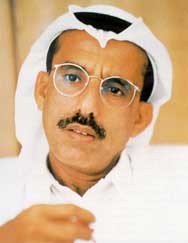
The latter part of the 20th Century saw the rest of the nations of the world realise that if they too wanted to prosper and thrive, they would have to educate their citizens so they would be better able to compete in the global free market system. Now at the beginning of the 21st century we are entering a new era, that of knowledge-based information technology, where our concepts of work and our means of earning our living will be based on what we know. Any society that wishes to see itself and its citizens prosper will have to ensure that it is able to deliver the right sort of education to its citizens if it does not want to get left at the starting gate by those societies that do. This brings me to the question, "What are we Arabs doing to develop education in our countries?” Will our education systems be flexible enough to equip our future citizens with the right skills to compete in the new information based global economy, or will we, as so often in the past, fail to react fast enough to the changes in the world’s economic systems? Are we going to be like the ostrich and forever keep our heads in the sand, ignoring the lessons that modern history has to offer? No Arab nation has yet understood how serious a failure in education will be for our countries. We must, at once, make drastic changes to our archaic educational systems that emphasise rote learning handed down by the teacher above self learning by the student. We must introduce modern teaching practices to our educational systems to meet the demands of a fast changing world. This inflexible bureaucracy is allied to an inflexible curriculum that is based on teachers dictating facts to their students which they have to memorise and parrot back at exam time. There is no effort to teach students how to think and discover facts for themselves. It is not enough to fill our children’s heads with facts and figures learned by rote, we need to stimulate their brains to teach them how to think and how to manage their affairs on their own. The inability of our educational systems to be flexible is reflected in the present generation that is growing up without the ability to exercise their minds. They have gotten used to being given everything without having to do anything themselves: they have gotten used to being spoon-fed. They expect their governments to give them well paid jobs, which will involve them in little real work and certainly require no commercial or technical skills We cannot blame our children. There is nothing wrong with their minds, nor do they lack talent. The blame lies with us not questioning the syllabus or teaching methods adopted at home as well as school. Very few teachers will show their students how to collect and collate information in order to write essays or research projects. And very few parents have in their homes the books and reference sources that could help their child. What we don’t want is for our educational institutions to churn out students who are parrots, who have no thoughts, have no capacity for analysis and can therefore form no opinions. We want our children to leave the education system with the ability to think for themselves so that they can make original contributions to our societies for the benefit of all. The Arab world does not continues over lack universities or educational institutions but what it most definitely lacks is the quality that should be present in such institutions. Contributing to this overall lack of quality are bureaucrats who are more interested in publishing statistics on quantity rather than concentrating on providing quality. Experts have pointed out that the emphasis of quantity over quality in arab education blinds Ministries and officials to the need for a coherent review of strategy for the new millennium. They love to recite figures showing that the number of high school and college graduates is rising all the time. This is true of course, but what is the value of statistics that tell us little of the quality of the education received by our young. What the numbers fail to show is the deficiencies in a system that renders the majority of our graduates incapable of participating in developmental and research projects, let alone maintaining the discipline necessary to hold down a job. Arab educators should give support to creative teachers, who encourage their students to learn for themselves rather than those who prefer to hand down knowledge at the front of the classroom. Too often in the past teachers that seem unconventional in their teaching methods have been penalised and ignored. What should happen is that their teaching methods should be assessed carefully and if found to be sensible and effective should be seen as part of an evolution n teaching methods. Teachers should, like doctors or pilots be made to go on courses to update their teaching skills. This will ensure that they are able to teach their students skills that will be of use out in the real world. They must keep up with new theories and practices in education throughout the world, to ensure that the educational curriculum best serves the requirements of a fast changing world. To encourage changes of attitude and teaching methods in our teachers we must reassess the value we place on them. We should value their contribution to our societies. We should reflect this value by paying them well, and show them respect within their communities. For, in the end, it comes down to maintenance of quality, whether in selecting teacher trainees, offering appropriate training throughout their careers or ensuring that working conditions and salaries are satisfactory. As was said earlier the latter part of the 20th Century saw great strides in Arab education. But education itself has undergone revolutionary change around the globe. The arrival of computers, the establishing of the world wide web and the focus on new subjects and teaching methods has made it imperative for Arab educators to create new strategies to meet the challenges of this post industrial, technologically driven new age. Let them not lose sight of the fact that knowledge and information will be the basis of power in this century. Arabs need to harness this power to gain strength. The only way to do this is to effectively educate our young. It is, therefore, important that our curriculums be shaped to turn out men and women who are capable of fulfilling important roles within our communities. As the world constructs new forms of social interaction that place a high value on people able to create wealth in the new global economy we do not want to be left behind. Many are worried that, by striving to adapt our traditional societies to this new information age much of our culture and tradition will be eroded. But this need not be the case; we can combine our worldly and spiritual goals to create a mix of enlightened progress that allows us to retain our cultural identity while at the same time moving forward with the secular world. Islam emphasises the importance of education for both men and women. Our Holy Prophet’s (peace be upon him) injunction "seek knowledge even from China", gives support to the pursuit of learning and an obligation on us to expand our knowledge. We should recall that the golden age of Islam was a time when education, ideas and open discussion prevailed. During this period students would travel great distances to hear and learn from great scholars and intellectuals, discussing not only Islamic teaching and ideas but also those of Socrates, Aristotle, Ptolmy and others. As a result of this contact with world ideas and thought, Arab societies from Baghdad to Cordoba produced great intellectuals like Al Farabi, Al Kindi, and Al Khwarizimi. These three gave the world a new mathematical system and Algebra, while others produced advances in medicine and chemistry. So if we wish to see greatness again we should strive to create a climate where, within the framework of our cultural heritage, ideas and the promotion of new forms of learning can be discussed freely. We do not want populations of robots mouthing the same tired ideas, rather, we require well-educated citizens who can take on the responsibilities of a civil society. Education in itself does not guarantee jobs to everyone and it does not guarantee that our societies will change for the better, still education remains a necessity as it builds in people self-confidence, a better understanding of the world and enables our talented young to fulfil their potential. In fact, without education life itself is incomplete. So it is imperative that all Arab governments construct a modern educational system that can offer specialised education that does not erode our beliefs. Time waits for no man. Therefore, instead of tying up the need for change in endless debate we must reform our systems now before we are once again left at the starting post by other societies that are better able to respond to the challenges of the fast changing global economy. It may be difficult at first as hard measures will have to be taken, but there are real rewards for us if we do so. We may, for the first time for many centuries, be in a position to lead rather than follow. KHALAF AL HABTOOR |
 It has been demonstrated that societies who provide the right education for their citizens will be better able to compete and prosper. Throughout the 20th Century, countries such as Britain, Germany, Japan and the United States have established compulsory education for their young and provided high quality schools and universities for their citizens. This enabled them to surge ahead of the rest of the world, dominating world markets and forcing all other nations to follow their lead. Their economic supremacy was based on their education systems, which produced literate citizens able to take advantage of the inventions and technological innovations stemming from the 19th Century Industrial Revolution in Britain.