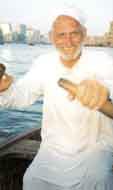

The supporting cast of Dubai may not get star billing, but it’s their talents and stories that give our desert metropolis its special character. Al Shindagah launches a new series to spotlight some of the bit players who help stage the daily drama. By Vincent White
My name is Abdullah Ali Ahmed Diwani. I was a fisherman with a spear and net in my village in south Iran, and it’s been thirty years since I came to Dubai...”
I met Abdullah one evening because of a change in routine, a shift of perspective that reveals a detail missed in the blur of a busy schedule. I stumbled out of an office in Bur Dubai late at night, bleary eyed from too many hours staring at a computer monitor. I paused at the building entrance and took a deep breath. The night air revived me, so on an impulse I snubbed the taxis tooting for attention and decided to walk to the Creek and take an abra ferryboat to get back home on Deira side.
The streets bustling just hours before were almost abandoned, the electronics shops shuttered, the souq displays of gold baubles and gaudy textiles hidden behind padlocked doors. I meandered through unfamiliar alleyways without any bearing save the faintly fishy scent somewhere ahead. Another left, another right, and suddenly the sea water channel which bisects Dubai blocked my way.
The retreat of desert winter from the advance of summer had suspended smoke from the battle of the seasons in the humid air. As I stood on the misty shore, I could barely make out the perimeter of the new cobblestone quay that stretches from the old custom house near the mouth of the Creek, past Sheikh Said’s restored mud palace in Shindagha and inland towards the British Embassy compound.
An overloaded wooden cargo ship loomed through the mist, claxon blaring, its muffled motors propelling it down the channel on its way to where, Bandar Khomeini? Karachi? Mogadishu? I started off along the corniche to the abra station, and in the darkness chanced upon a circle of warm light glowing from a cafe still serving the evening’s stragglers. The tantalising scent of roasting shawarma reminded me that I hadn’t eaten dinner, so I ordered some sandwiches and seated myself outside next to the embankment.
My waiter’s bushy moustache and bright black eyes summoned memories of student days in Istanbul. “Turk musunuz?” I ventured hesitantly. “No, Kurdish,” he grinned, “from Iran.” With only a few words from several languages shared between us, our brief attempt at conversation was futile. “You USA? Very good!” The exchange provoked the curiosity of the young proprietor who introduced himself as Ismael, evidently eager to practise his language lessons from the British Council. He hailed from a village in southern Iran named Khonj, and as chance would have it, I knew several people there. We discovered that we had friend in common, enough of a cause to celebrate that my new friend commanded a round of Turkish coffees.
We chattered away, ignoring the spectacle of the shrouded Creek at our elbows. The coffee fuelled a free-wheeling discussion of business in Dubai, the change of regime in Iran, and life back in ‘Tehrangeles’, the Iranian nickname for their favourite city in the USA. The remaining customers had exited, so the waiters pulled chairs close to our small table to listen and nod approval of their young boss’s demonstration of English skills.
Inside the cafe someone began turning off the lights, and I suddenly realised it was already past one. “Oh! I’ve got to catch the abra!” I bolted up and asked for the bill, but was refused as though I had offended the whole nation of Iran by referring to money. I protested, as did they, as did I again. They outnumbered me and after decades in the Middle East I knew that this was a ritual I was not meant to win, and besides, I was late. With profuse thanks and promises of eternal friendship, I had already started to leave when I was brought up short with “But the abras are finished now!”
I hadn’t realised that after midnight the ferries stop their hectic shuttle across the Creek. I groaned at the prospect of retracing my route through the souq to find a taxi. “No problem, don’t worry!” my new friend announced as he took my arm firmly to steer me down to the edge of the embankment. He whistled shrilly into the mist. I stared at him and then into the murky whiteness, clueless as to what to expect.
A silent minute later a shadowy form began to emerge through the fog, a dark silhouette of a thin figure standing in a small skiff, laboriously rowing towards us with short thrusts of oars. The old man wore a soiled grey kandura, the long tunic of the Gulf, and the white of his skullcap and closely cropped hair and whiskers shone in the darkness. The oars creaked as they broke the still black surface of the water. Good grief, I thought, it’s Charon, death’s ferryman come to transport me to Hades.