
Vincent White takes a look at the latest addition to Dubai’s impressive tourism line-up.
The shuttle bus left immigration control and made its way along the busy docks. The passengers craned their necks and chatted excitedly in several languages as they oogled the paraphenalia of a habour in motion, gigantic cranes and angled gangways and towering piles of steel containers stacked like Legoland gone mad. Flags from around the world fluttered from the sterns of ships jostling for space along the crowded wharves.
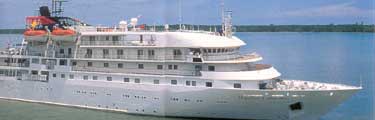
The bus pulled to a stop beside a gleaming white cruise liner and the passengers trooped up the gangway with their luggage to be greeted by several petite stewardesses and a smart-looking officer. “Welcome to the Cruise to Nowhere!”
Say wha…? Is this a time warp welcome to the Twilight Zone? The X Files? Salvador Dali’s Surreal Time Cruisers? Guess again habibi, because the habour was none other than Dubai’s very own Port Rashid, and the cruise liner the latest star attraction of the tourism line-up of the United Arab Emirates. So what’s with the “Cruise to Nowhere”? Good question, but the answer comes later.
Star Cruises is the first international cruise company to attain the coveted status of a truly globalised operation. From its base in Malaysia, the company now operates throughout the Asia Pacific region, Europe, the Caribbean and even Antarctica. To start the new millennium off with a bang, Star was proud to announce the designation of its newest homeport, Dubai.
T.J. Tan is the General Manager of the company’s Dubai office, and he described for Al Shindagah how the operational base for the new Middle Eastern venture was selected. “After the consolidation of Star’s position in Europe and the Americas with our purchase of Norwegian Cruise Lines, we thought that it was the right moment to pay attention to the Middle East.
“The region has been underserviced by the cruise industry, particularly the Gulf region. The reason why is that cruising, and tourism in general, are allergic to instability. The GCC states, however, have grown into a solid economic base for an operation like ours, and there has now been quite a few years of stability in the region. We decided therefore that it was time for Star to develop the Gulf as the link between our strong Asian Pacific base and our expanding European operations.
“Why Dubai? We’re most interested in the markets of Saudi Arabia, Kuwait and the UAE. Dubai courted us with a lot of determination, much to their credit. They had made an impressive investment in port infrastructure, and the geographic position of the city was also more convenient than the alternatives.”
Mr. Tan leaned forward to emphasise his next point. “The final clincher for the decision about Dubai was the effort of the authorities here to make things work for us. Their policies of openness to new ideas and their eagerness to do business are well known. It wasn’t just talk. Dubai had a good package to offer, and we accepted. We haven’t regretted it.”
Companies that are global players don’t usually find governments which actually facilitate business rather than hindering it. Dubai is trying hard to be the exception to that rule. The main agency for the development of the tourist industry in Dubai is the Department of Tourism and Commerce Marketing, and the official with the inside track on the whys and hows of the Star Cruise story is the Senior Manager of its Projects Division, Abdulrahim Mohammed Abdullah.
“To develop and promote Dubai’s tourism potential, DTCM has been implementing a master plan for quite a while. Dubai’s tourism goal is to develop a spectrum of quality attractions to pull in a wide variety of visitors, and make them happy enough to return. Each different sector requires its own effort, whether it be hotels or the desert or the beach. We’ve been targeting the cruise industry since 1992 and within a year of starting, we scored our first visit from an international cruise liner. Since then we’ve gradually put Dubai on the map as a unique landfall for long haul cruises between Asia and Europe.